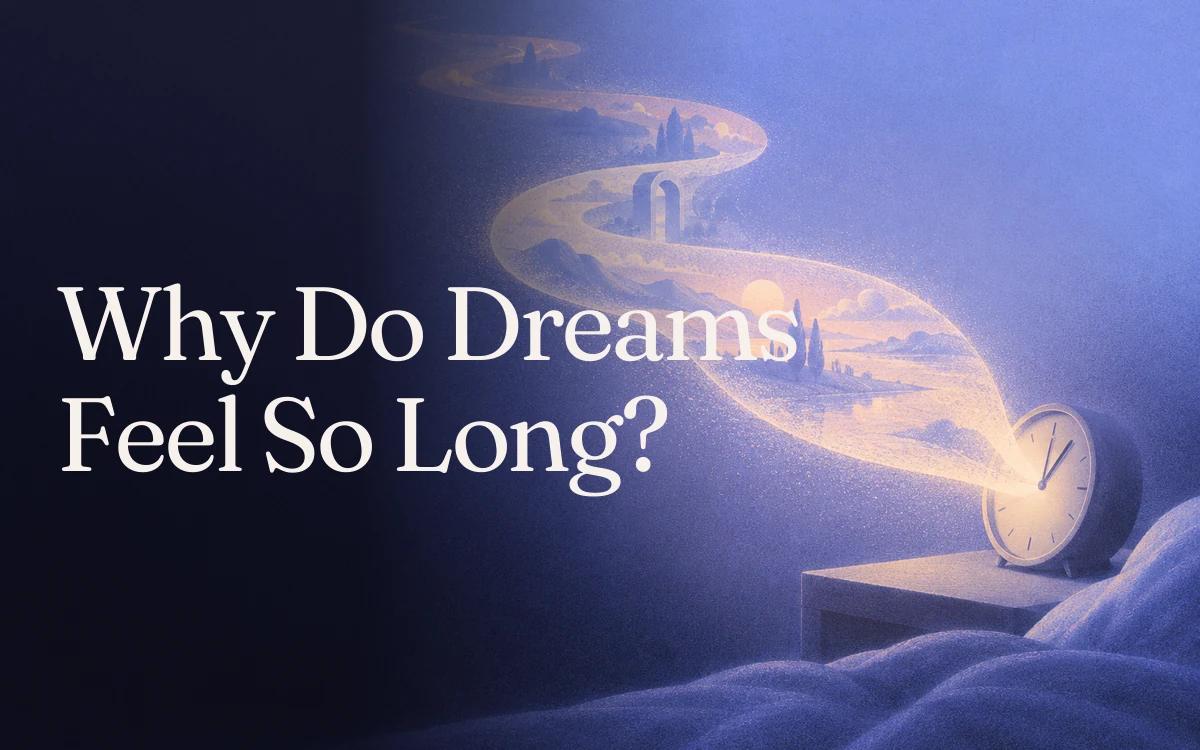
A long dream is not necessarily a long night
Some dreams arrive with the scale of a film. You remember leaving home, travelling somewhere unfamiliar, meeting someone, solving a problem and returning, all within what seems to have been a single night. It is tempting to assume that the dream must have lasted hours. But the feeling of duration and the measured time spent asleep are not the same thing.
Dreams are experiences assembled from images, emotion, thought, memory and changing scenes. When you wake, the report you remember is already a reconstruction. It may contain a sequence that feels continuous even though it was fragmented, or it may skip over long stretches without making the gaps obvious. A dream narrative can therefore have a rich sense of history without being a minute-by-minute recording.
This distinction matters because dream reports are valuable descriptions of experience, not direct clocks. Researchers usually estimate dream timing through awakenings, pre-arranged tasks or lucid-dream signals, and each method measures something slightly different. A vivid sense of ‘all night’ should be taken seriously as an experience without being treated as proof of literal elapsed time. 3 4
What lucid-dream timing experiments found
Lucid dreams offer a rare way to study subjective time while a person is still dreaming. In a lucid dream, the dreamer knows they are dreaming and can sometimes follow instructions agreed before sleep. Researchers can ask participants to signal with predetermined eye movements when they begin and finish a task, while their sleep is monitored.
In one influential line of experiments, lucid dreamers counted or carried out simple actions and signalled their progress. For many straightforward tasks, dream time was close to waking time rather than being dramatically accelerated or slowed. That finding challenges the popular idea that an entire lifetime can routinely unfold in a few seconds of sleep. 1
The result does not mean every dream feels exactly like waking life. More complex actions, emotional intensity, scene changes and the limits of memory can alter the experience. A person may dream an elaborate journey that seems to take a day, while the measurable task inside the dream takes much less time. The experiment is a useful anchor, not a complete explanation of every long dream.
Why the story can feel longer than the clock
A dream can imply time without showing it. You may know that you have been living in a house for years, waiting for a train for hours, or travelling through several countries, even though the dream only presents a few scenes. The mind supplies context and continuity in the same way a novel can suggest a character’s history without describing every day.
Dreams also change scenes abruptly. A bedroom becomes a street; a stranger becomes a sibling; daylight turns to evening without a journey between them. After waking, memory may connect those scenes into a smoother account. That reconstruction can create a sense of extended duration because the remembered story includes transitions and background that were not experienced in full.
Emotion adds another layer. Fear, grief, wonder and urgency can make a brief episode feel spacious and significant. Repetition can have the opposite effect, making a long sequence feel like one compressed moment. The subjective length of a dream is therefore shaped by attention, narrative structure, novelty, emotion and recall—not by one universal dream-time multiplier. 2 4
Sleep stage, awakenings and memory change the report
Dreaming is reported from both REM and non-REM sleep, and the kind of experience can differ across sleep states. REM dreams are often described as vivid, visual and narratively developed, while non-REM reports can be more thought-like or fragmentary. These are broad tendencies rather than rules, and the report depends heavily on when and how the person is awakened.
An awakening gives the dream a chance to enter waking memory. Without that bridge, the experience may leave no reportable trace. With it, the mind still has to organise fragments into language. A long dream report may partly reflect the amount of material that was available for recall and the way waking memory arranged it, not the exact amount of time the dream occupied.
Modern dream research also warns against treating REM as a simple synonym for dreaming. Brain activity associated with dream experience appears in more than one sleep condition, and dream phenomenology varies with the sleeping state and the person. The safest conclusion is that dream duration is reported experience shaped by sleep physiology and memory together. 2 4
How to reflect on a dream that felt endless
If a dream felt unusually long, start by recording the sequence as you remember it, then mark the points where the scene changed. Which moments felt lived-in, and which were simply understood? Did the dream contain a clear passage of time, or did it give you the knowledge that time had passed? This can reveal whether the feeling came from repetition, narrative context, emotion or a genuine sense of waiting.
You can also ask what the apparent length did to the dream. Did an extended journey make you feel patient, trapped or hopeful? Did a lifetime with a stranger feel comforting or unsettling? These questions treat the dream as personal material rather than a universal code. A long-feeling dream may invite reflection on an experience that feels larger than the time you have available, but it does not predict how long something will last.
If you want to remember the sequence more clearly, keep a notebook nearby and write before checking your phone. Our guide to remembering dreams offers a simple routine, while dreams that feel real explores vividness and waking certainty. For the broader question of what dreams may be doing during sleep, see why we dream.
The useful answer
Dreams can feel long because subjective time is constructed from attention, emotion, memory and the story-like way scenes are connected. Lucid-dream experiments suggest that simple actions often take approximately real time, but that does not prevent a dream narrative from implying years, days or an entire journey. The report is an experience and a reconstruction, not a perfect record of elapsed sleep.
You do not need to decide whether a long dream was ‘really’ hours long before it can matter to you. Write down what remained, notice where the dream expanded or skipped, and let its meaning stay open. The most honest reading is usually the one that respects both sides: the dream felt long, and the clock may tell a different story.
Frequently asked questions
Can a dream really last for hours?
A dream can feel as though it lasted hours, but that feeling is not a precise measurement. Lucid-dream timing studies often find simple tasks take roughly real time, while dream narratives can imply much longer periods through scene changes, memory and emotional context.
Why did my dream feel like an entire day?
A dream may imply a day through skipped transitions, background knowledge, repeated scenes and a remembered storyline. Waking memory can connect fragments into a continuous sequence, making the dream feel more extended than the measured sleep interval.
Do dreams happen in real time?
There is no single answer for every dream. Studies of lucid-dream counting and simple motor tasks suggest many dream actions take approximately real time, but subjective duration can still expand or contract as the dream changes scene or emotion.
Does REM sleep make dreams longer?
REM dreams are often reported as vivid and narratively developed, but dreaming also occurs in non-REM sleep. How long a dream feels depends on sleep state, awakenings, attention and memory, not REM alone.
Does a long dream have a special meaning?
Not automatically. Its apparent length may reflect emotion, repetition, narrative context or how waking memory reconstructed it. You can explore what the duration felt like without treating it as a fixed symbol or prediction.