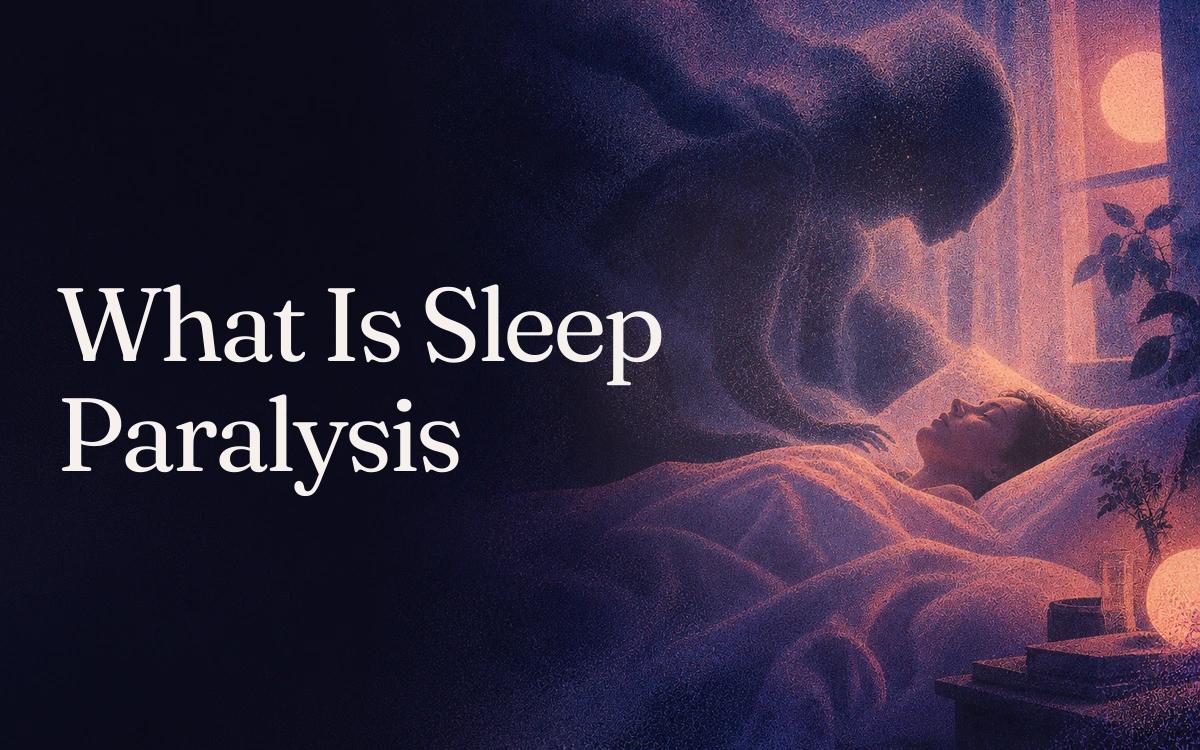
What Is Sleep Paralysis?
Sleep paralysis is a brief period when you are aware—often just after falling asleep or while waking—but cannot move or speak. It is linked to REM sleep muscle atonia, and it can feel frightening, especially when vivid images or a sense of presence appear. It is usually temporary and is not the same thing as a typical dream story 12.
Many people first meet sleep paralysis in the middle of the night: eyes open, mind alert, body still. A room can feel charged with presence. Breathing may feel effortful. A figure may seem to stand nearby. Afterwards, it is natural to ask whether it was a nightmare, a spiritual encounter, or something medical.
At Dreamia, we want to keep this conversation warm and clear. Sleep paralysis sits at the edge of sleep science and lived experience. Understanding the biology can make the episode less mysterious—without dismissing how intense it feels in the moment. This guide is educational, not medical advice.
A Science-Led Explainer
REM sleep and muscle atonia
During REM sleep, the brain is highly active and dreaming is common. At the same time, most skeletal muscles are temporarily inhibited—a protective state called atonia that helps stop us from acting out dream movements 13. In ordinary sleep, awareness and atonia end together. In sleep paralysis, awareness returns while atonia briefly continues, which can create the unsettling mix of being awake enough to notice the room and still unable to move 12.
How sleep paralysis differs from dream content
A dream usually unfolds as an inner narrative while you are asleep. Sleep paralysis is better described as a mixed state: elements of REM sleep (atonia and dream-like imagery) overlapping with wakeful awareness of the bedroom 2. That is why people often report being able to see the actual room, hear household sounds, or feel the mattress—while also experiencing hallucinations that do not belong to ordinary waking life.
Those hallucinations are commonly described as hypnagogic (while falling asleep) or hypnopompic (while waking). Research and clinical summaries often group them into themes such as an intruder or sensed presence, chest-pressure or incubus-like sensations, and vestibular-motor experiences such as floating or out-of-body feelings 12. About three-quarters of episodes may include hallucinations of some kind 2.
How common is it?
Prevalence estimates vary widely depending on how questions are asked. A systematic review notes that lifetime prevalence in the general population has been estimated around 8%, with individual studies ranging much higher or lower 4. Public sleep-health summaries sometimes cite roughly one in five people experiencing sleep paralysis at some point 2. The exact number matters less than the reassurance: many people have this experience, and a single episode does not automatically mean something is wrong.
Common Experiences During an Episode
People often describe one or more of the following:
- Inability to move arms, legs, or speak, even while feeling mentally awake
- A sense of pressure on the chest, or difficulty taking a full breath
- A felt presence, shadow figure, or “demon” image near the bed
- Fear, panic, or helplessness that can linger after the body unlocks
- Less often, floating, vibrating, or out-of-body sensations
Episodes are often brief—seconds to several minutes for many people—and usually end on their own, or when someone touches or speaks to the person 2. Knowing that the state tends to pass can make the fear slightly less absolute while it is happening.
Waking-Life Considerations
Researchers have linked sleep paralysis with disrupted or irregular sleep, stress and trauma-related symptoms, anxiety, and certain sleep disorders; associations with PTSD appear especially notable in systematic reviews 4. It can also occur in isolation, without narcolepsy, though recurrent patterns sometimes raise the question of an underlying sleep condition that deserves professional assessment 12.
Practical supports that many people find grounding include steadier sleep timing, reducing evening alcohol and caffeine, managing stress where possible, and making the bedroom feel safer and quieter. For some, gently focusing on small movements—such as a finger or toe—or remembering that the episode is temporary may ease panic 2. If episodes are frequent, intensely distressing, or paired with excessive daytime sleepiness or sudden sleep attacks, speaking with a qualified clinician is a wise next step.
It also helps to separate meaning from mechanism. Cultural stories about night visitors have existed for centuries, and they can shape how an episode is remembered 25. Those stories are part of human sense-making. The science does not erase the emotional intensity; it simply offers another frame: your nervous system may be bridging REM and wakefulness in a clumsy, temporary way.
FAQs
Is sleep paralysis dangerous? For most people, isolated episodes are considered benign, though they can be emotionally distressing and may disrupt sleep if fear of bedtime develops 2. Persistent or complicated patterns deserve clinical attention.
Is the “sleep paralysis demon” real? The sensed presence can feel utterly convincing. Science usually understands it as a hallucination occurring during a REM-wake overlap, not as proof of an external being 12. Your fear is still valid either way.
Is sleep paralysis a dream? It can include dream-like imagery, but the defining feature is conscious awareness during lingering muscle atonia. That mixed state is why it often feels more “in the room” than an ordinary dream 2.
A Calm Final Thought
If you have experienced sleep paralysis, you are not alone, and you are not imagining the intensity. Your body may simply have woken a little ahead of its motor systems. Soften the lights, steady your breath, and give yourself time to come fully back. Understanding the science will not erase every eerie moment—but it can turn a night of confusion into something more nameable, and therefore a little kinder.
For comparison, feeling paralysed inside a dream concerns the dream scene itself. Our guides to nightmares and a dream within a dream explore other experiences that can make the boundary between sleeping and waking feel unsettling.
Frequently asked questions
What is sleep paralysis?
Sleep paralysis is a temporary inability to move or speak while you are aware, usually as you fall asleep or wake up. It is linked to REM sleep muscle atonia continuing briefly into awareness.
Is sleep paralysis a dream or something else?
It can include dream-like hallucinations, but it is not the same as an ordinary dream. Many people remain aware of the real room while REM-related paralysis and imagery overlap with wakefulness.
Is sleep paralysis dangerous?
For most people, isolated episodes are not considered dangerous, though they can be frightening. If episodes are frequent, highly distressing, or come with other sleep symptoms, speak with a clinician. This is not medical advice.
Why do people see a demon or presence during sleep paralysis?
Many people report a sensed presence or figure. Sleep research usually understands this as a hallucination during a REM-wake mixed state, shaped in part by fear and culture. The experience can feel real even when it is generated by the sleeping brain.
How can I stop or reduce sleep paralysis?
Improving sleep regularity, reducing sleep disruption where possible, and lowering bedtime stress may help some people. Gentle focus on small movements and reminding yourself that the episode usually passes can also ease panic. Seek professional care for recurring or complex cases.